
Residential Elevator vs. Stairlift: Which One Actually Makes Sense for Your Home?
July 24, 2026
At some point, many homeowners start thinking about the stairs differently. Maybe it's after a knee surgery, or watching a parent struggle with a heavy laundry basket, or just the realization that a house you love should still work for you twenty years from now. Whatever the reason, you start looking at your staircase and wondering if there's a better way.
Two options come up most often: a stairlift or a residential elevator. Both solve a real problem, but they're not interchangeable — and choosing the wrong one can mean spending money on something that doesn't actually fit your life. Here's an honest breakdown of both.
What a residential elevator actually is
A home elevator is a fully enclosed cab that moves between floors — similar in concept to what you'd find in a commercial building, just designed and sized for a private home. Modern versions are a far cry from the clunky, boxy installations of decades past. They can be built to match almost any interior aesthetic, from sleek and contemporary to traditional millwork that blends right into the architecture.
Beyond accessibility, homeowners often find they use their elevator constantly for things that have nothing to do with mobility: groceries, luggage, laundry, furniture, holiday boxes coming down from the attic. For multi-story homes, it just becomes part of how the house functions.
Elevators can accommodate wheelchairs, walkers, and other mobility devices, which means users don't have to transfer out of one device to use the system. That's a meaningful distinction when you start thinking about long-term needs.
What a stairlift is — and isn't
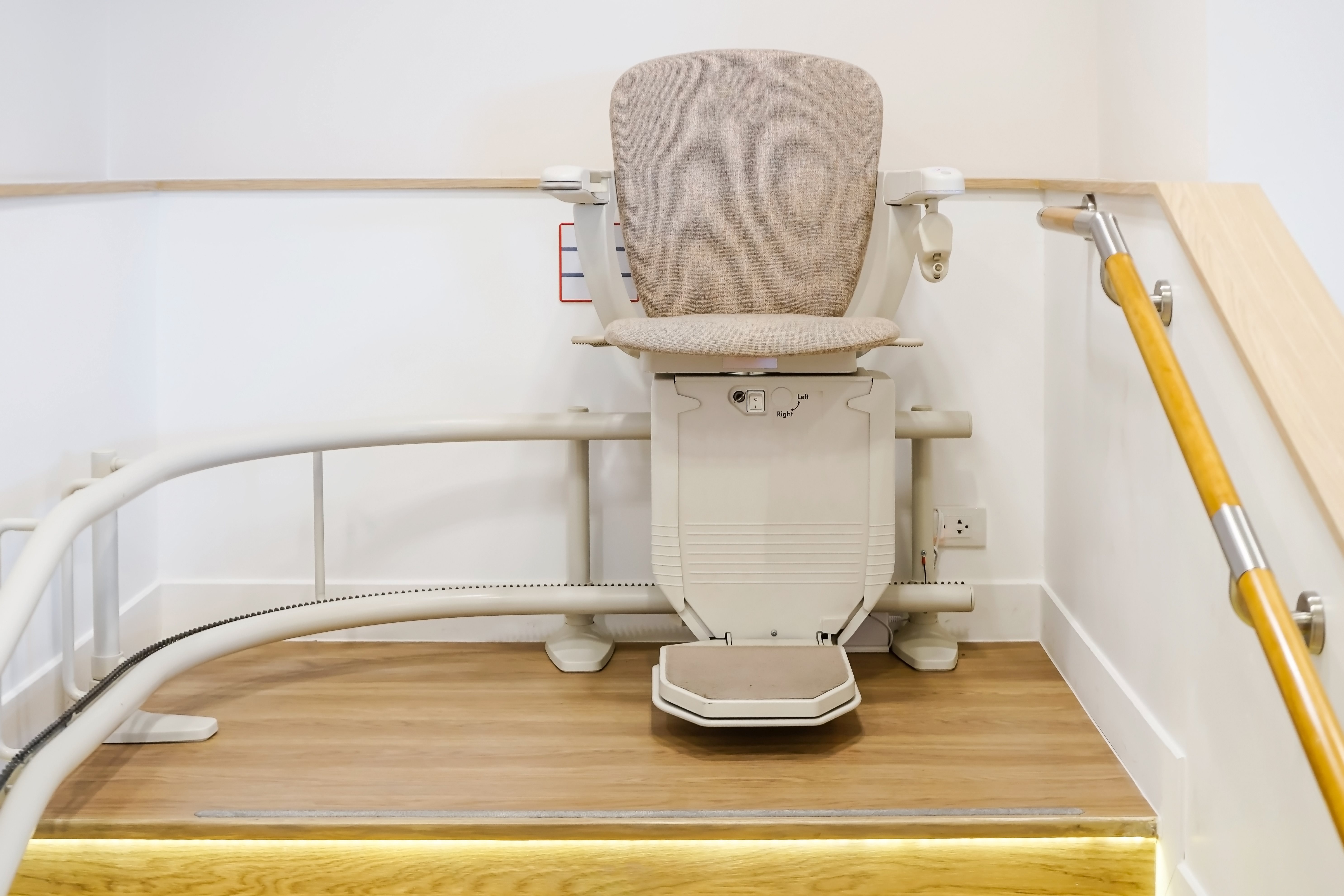
A stairlift is a motorized chair mounted on a rail that runs along your staircase. You sit down, ride up or down, and stand up when you get there. Simple, relatively fast to install, and often less expensive upfront.
Stairlifts tend to work best when the mobility challenge is relatively minor or potentially short-lived — a recovery from surgery, a gradual decline in strength, that kind of thing. They can be set up for both straight and curved staircases without touching the walls or structure of your home, which is a genuine plus.
Where they fall short is for anyone with more serious limitations. You have to be able to sit down, buckle in, ride the chair, then get yourself up and stable on the other end — every single time. If you use a wheelchair, that's a non-starter. And you're never carrying anything with you, so the stairs are still part of your daily routine in that sense.
The question of aging in place
This is where the two options diverge most significantly.
If you're planning to stay in your home long-term — and most people are — you need a solution that can adapt as your needs change. A stairlift might work fine today, but if your mobility situation evolves, you could find yourself needing to replace it with something more capable anyway. That's two rounds of cost and disruption instead of one.
An elevator handles a much wider range of mobility levels and serves multiple people in the household — guests, caregivers, aging family members, anyone. It's also something future buyers will see as a genuine amenity rather than a medical device.
For homeowners in the Carolinas who are building new or doing a significant renovation, there's also a practical argument for incorporating an elevator during construction. Adding one later is absolutely doable, but planning for it from the start tends to be cleaner and more cost-effective.
Installation: What to expect
The tradeoff with elevators is that they require more upfront planning. You'll need dedicated shaft space, structural work, and professional installation. It's a real project, not an afternoon's work. In new construction, this is straightforward to accommodate. In an existing home, it depends heavily on the layout, but retrofitting is common and usually more feasible than homeowners initially expect.
Stairlifts, by contrast, can often be installed within a day or two. The rail mounts to the staircase itself, the electrical work is minimal, and there's little to no structural impact on the home. If speed matters — say, someone is coming home from a rehabilitation stay — a stairlift can be a faster bridge solution.
So which one is right for you?
Honestly, it depends on what you're trying to solve and for how long.
If your needs are relatively straightforward right now, your staircase is the main obstacle, and you're not looking for a permanent solution, a stairlift can do the job. It's less expensive upfront and quicker to get in place.
If you're thinking about the long haul — or if wheelchair accessibility is a current or likely future need — a residential elevator is almost always the better investment. It's more versatile, more capable, and it adds to your home rather than just solving a problem.
At Alchemy Elevator, we work with homeowners across North Carolina and South Carolina to figure out what actually makes sense for their specific home and situation. If you're weighing these options and want to discuss what would work for you, we're glad to help.